


We all should be trying to educate ourselves at the moment, and a great place to start is with the books we read. The books in this list amplify black voices and their experiences and will help any non-black readers with their anti-racism journey.
We have to do better, and it has to start now. It’s not enough to not be racist, you have to be anti-racist too and by educating yourself, you can take the first steps in changing your perception and any implicit biases you may have. This list includes fiction and non-fiction books as well as memoirs.
(Disclaimer: For transparency and speed, the synopses written below are taken from the Waterstone’s website).

Girl, Woman, Other – Bernardine Evaristo
Girl, Woman, Other follows the lives and struggles of twelve very different characters. Mostly women, black and British, they tell the stories of their families, friends and lovers, across the country and through the years. Joyfully polyphonic and vibrantly contemporary, this is a gloriously new kind of history, a novel of our times: celebratory, ever-dynamic and utterly irresistible.
The Color Purple – Alice Walker
Set in the deep American South between the wars, The Color Purple is the classic tale of Celie, a young black girl born into poverty and segregation. Raped repeatedly by the man she calls ‘father’, she has two children taken away from her, is separated from her beloved sister Nettie and is trapped into an ugly marriage. But then she meets the glamorous Shug Avery, singer and magic-maker – a woman who has taken charge of her own destiny. Gradually Celie discovers the power and joy of her own spirit, freeing her from her past and reuniting her with those she loves.
The Bluest Eye – Toni Morrison
Unlovely and unloved, Pecola prays each night for blue eyes like those of her privileged white schoolfellows. At once intimate and expansive, unsparing in its truth-telling, The Bluest Eye shows how the past savagely defines the present.
The Water Dancer – Ta-Nehisi Coates
Compellingly recounting the clandestine work of abolitionist cells buried in the nineteenth-century Deep South, The Water Dancer is a fearless and profound slice of crusading historical fiction.
Things Fall Apart – Chinua Achebe
Okonkwo is the greatest wrestler and warrior alive, and his fame spreads throughout West Africa like a bush-fire. But when he accidentally kills a clansman, things begin to fall apart. Then Okonkwo returns from exile to find missionaries and colonial governors have arrived in the village. With his world thrown radically off-balance, he can only hurtle towards tragedy.
The Underground Railroad – Colson Whitehead
A nightmarish evocation of the moral torpor and unthinking brutality of the Antebellum South, Whitehead’s narrative thunders along with the relentless pull and desperate motion of the titular subterranean boxcar system that transported slaves across the United States. Furious, wise and unbearably poignant, The Underground Railroad stands as Whitehead’s supreme achievement.
The Blacker the Berry – Wallace Thurman
Emma Lou Morgan’s skin is black – ‘too black’, as the narrator writes at the beginning of The Blacker the Berry. Tired of the scorn and contempt of her classmates, teachers, friends and even family, she leaves her hometown of Boise, Idaho, travelling first to Los Angeles and then to Harlem, New York, in search of a community to which she can belong. In Harlem, Emma Lou finds an exciting, vibrant scene of nightclubs and dance halls and parties and love affairs … but there is no escaping the shame she feels about the darkness of her skin.
Their Eyes Were Watching God – Zora Neal Hurston
When sixteen-year-old Janie is caught kissing shiftless Johnny Taylor, her grandmother swiftly marries her off to an old man with sixty acres. Janie endures two stifling marriages before she finally meets the man of her dreams – who offers not diamonds, but a packet of flowering seeds.
The Hate U Give – Angie Thomas
Sixteen-year-old Starr lives in two worlds: the poor neighbourhood where she was born and raised and her posh high school in the suburbs. The uneasy balance between them is shattered when Starr is the only witness to the fatal shooting of her unarmed best friend, Khalil, by a police officer.
Queenie – Candice Carty-Williams
Caught between the Jamaican British family who don’t seem to understand her, a job that’s not all it promised and a man she just can’t get over, Queenie’s life seems to be steadily spiralling out of control. Desperately trying to navigate her way through a hot mess of shifting cultures and toxic relationships and emerge with a shred of dignity, her missteps and misadventures will provoke howls of laughter and tears of pity – frequently on the same page.
Such a Fun Age – Kiley Reid
When Emira is apprehended at a supermarket for ‘kidnapping’ the white child she’s actually babysitting, it sets off an explosive chain of events. Her employer Alix, a feminist blogger with a ‘personal brand’ and the best of intentions, resolves to make things right. But Emira herself is aimless, broke and wary of Alix’s desire to help. When she meets someone from Alix’s past, the two women find themselves on a crash course that will upend everything they think they know – about themselves, each other, and the messy dynamics of privilege.

Why I’m No Longer Talking to White People About Race – Reni Eddo-Lodge
Exploring issues from eradicated black history to the political purpose of white dominance, whitewashed feminism to the inextricable link between class and race, Reni Eddo-Lodge offers a timely and essential new framework for how to see, acknowledge and counter racism.
How to be an Antiracist – Ibram X Kendi
In this rousing and deeply empathetic book, Ibram X. Kendi, founding director of the Antiracism Research and Policy Center, shows that when it comes to racism, neutrality is not an option: until we become part of the solution, we can only be part of the problem.
So You Want to Talk About Race – Ijeoma Oluo
So You Want to Talk About Race, editor-at-large of The Establishment Ijeoma Oluo offers a contemporary, accessible take on the racial landscape in America, addressing head-on such issues as privilege, police brutality, intersectionality, micro-aggressions, the Black Lives Matter movement, and the “N” word. Perfectly positioned to bridge the gap between people of color and white Americans struggling with race complexities, Oluo answers the questions readers don’t dare ask, and explains the concepts that continue to elude everyday Americans.
The New Jim Crow – Michelle Alexander
Lawyer and activist Michelle Alexander offers a stunning account of the rebirth of a caste-like system in the United States, one that has resulted in millions of African Americans locked behind bars and then relegated to a permanent second-class status, denied the very rights supposedly won in the Civil Rights movement.
White Fragility – Robin Diangelo
Anger. Fear. Guilt. Denial. Silence. These are the ways in which ordinary white people react when it is pointed out to them that they have done or said something that has – unintentionally – caused racial offence or hurt. But these reactions only serve to silence people of colour, who cannot give honest feedback to ‘liberal’ white people lest they provoke a dangerous emotional reaction.
White Rage – Carol Anderson
Carefully linking […] historical flashpoints when social progress for African Americans was countered by deliberate and cleverly crafted opposition, Anderson pulls back the veil that has long covered actions made in the name of protecting democracy, fiscal responsibility, or protection against fraud, rendering visible the long lineage of white rage.
Ain’t I A Woman – Bell Hooks
In this classic study, cultural critic bell hooks examines how black women, from the seventeenth century to the present day, were and are oppressed by both white men and black men and by white women.
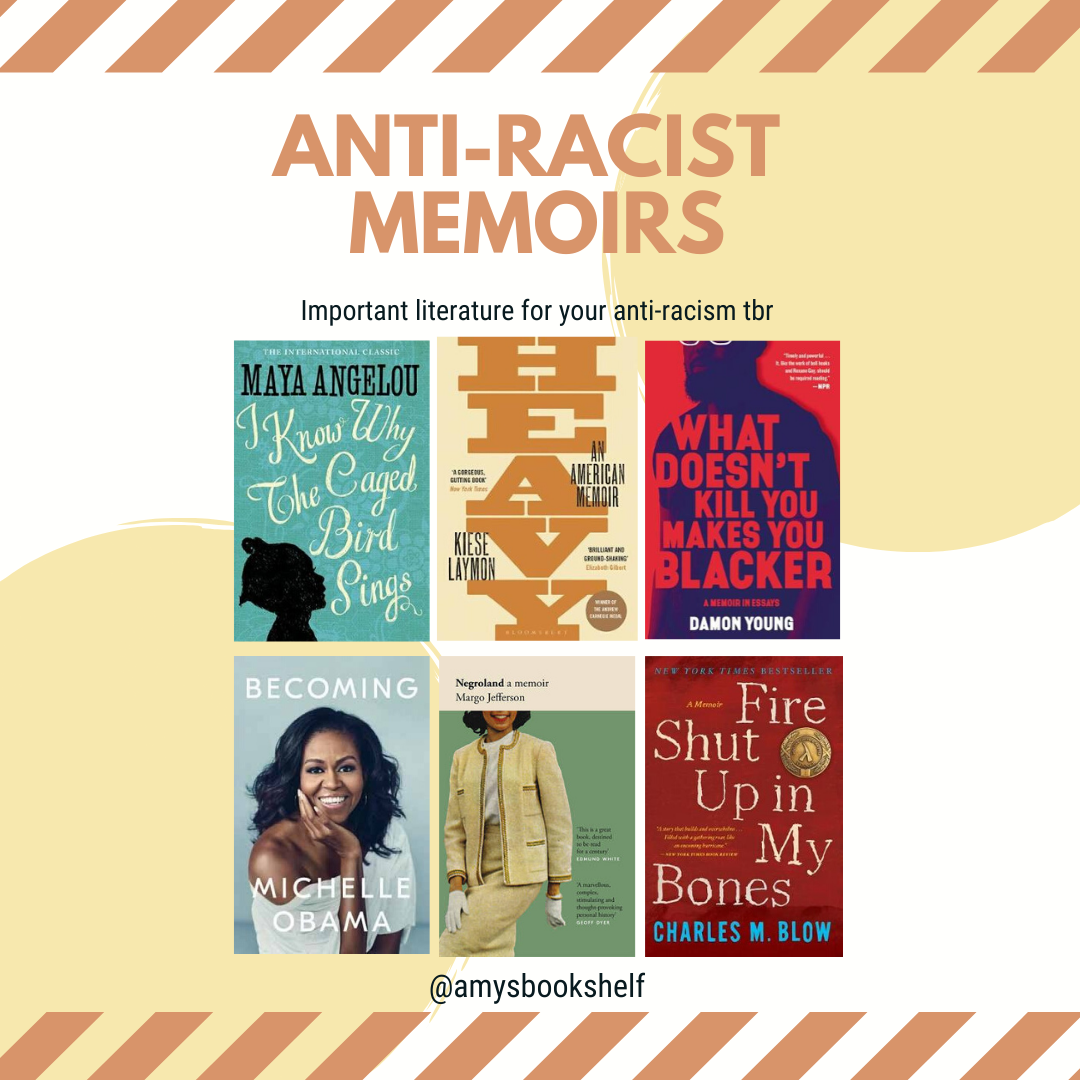
I Know Why the Caged Bird Sings – Maya Angelou
In I Know Why the Caged Bird Sings, Maya Angelou beautifully evokes her childhood with her grandmother in the American south of the 1930s. She learns the power of the white folks at the other end of town and suffers the terrible trauma of rape by her mother’s lover.
What Doesn’t Kill You Makes You Blacker – Damon Young
For Damon Young, existing while Black is an extreme sport. The act of possessing black skin while searching for space to breathe in America is enough to induce a ceaseless state of angst where questions such as “How should I react here, as a professional black person?” and “Will this white person’s potato salad kill me?” are forever relevant. What Doesn’t Kill You Makes You Blacker chronicles Young’s efforts to survive while battling and making sense of the various neuroses his country has given him.
Heavy – Kiese Laymon
From his early experiences of sexual violence, to his suspension from college, to his career as a young college professor, Laymon charts his complex relationship with his mother, grandmother, abuse, anorexia, obesity, sex, writing and ultimately gambling. In Heavy, by attempting to name secrets and lies that he and his mother spent a lifetime avoiding, Laymon asks himself, his mother, his nation and us to confront the terrifying possibility that few know how to love responsibly, and even fewer want to live under the weight of actually becoming free.
Negroland – Margo Jefferson
Far more a state of mind than any true geographic location, the ‘negroland’ of Margo Jefferson’s title describes a condition of relative African-American privilege, the social strata she herself was born into. It is a brilliant, freewheeling account – bearing the ‘experimental and experiential quality of jazz,’ as The Guardian put it – pulling in all manner of panoptic moment. From the energies of the civil rights movement through to the fallacies of post-racial America, at every turn Jefferson applies her Pulitzer-winning vision to extraordinary effect. It’s an extraordinary social kaleidoscope and perfectly timed for the America emerging today.
Fire Shut Up in My Bones – Charles M. Blow
Charles M. Blow’s mother was a fiercely driven woman with five sons, brass knuckles in her glove box, and a job plucking poultry at a factory near their town in segregated Louisiana, where slavery’s legacy felt close. When her philandering husband finally pushed her over the edge, she fired a pistol at his fleeing back, missing every shot, thanks to “love that blurred her vision and bent the barrel.” Charles was the baby of the family, fiercely attached to his “do-right” mother. Until one day that divided his life into Before and After – the day an older cousin took advantage of the young boy. The story of how Charles escaped that world to become one of America’s most innovative and respected journalists is a searing, redemptive journey that works its way into the deepest chambers of the heart.
Becoming – Michelle Obama
In her memoir, a work of deep reflection and mesmerizing storytelling, Michelle Obama invites readers into her world, chronicling the experiences that have shaped her-from her childhood on the South Side of Chicago to her years as an executive balancing the demands of motherhood and work, to her time spent at the world’s most famous address.